
Emergency Garage Door Repair Near Me: What Huntsville Homeowners Should Do First
A garage door stuck open isn’t just an inconvenience. It’s an open entry point to your home, and in Huntsville, where most houses have direct garage-to-house access, that problem starts the second the door fails. Here’s the short version of what to do: don’t touch the springs or cables, secure the opening if the door won’t close, and call a technician with your door’s brand and model ready. The first ten minutes decide whether this stays a repair or turns into an injury and a break-in. If you’d rather skip the guesswork, call (855) 632-2899. We answer 24/7.
Key Takeaways
- Never touch a spring or cable under tension – that’s how people get hurt.
- If the door is stuck open, secure the opening first, then call.
- The emergency release cord is a tool with rules – know when not to pull it.
- Have your door brand and model ready so the technician arrives with the right part.
- Two numbers on any quote tell you whether the pricing is fair.
First, Assess the Door Before You Touch Anything
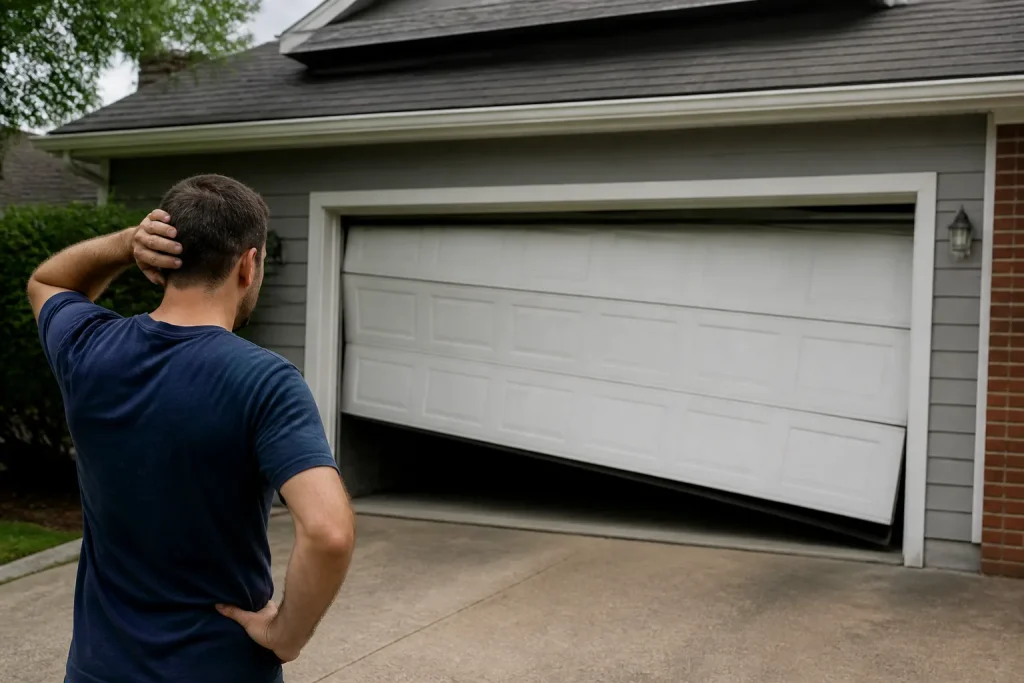
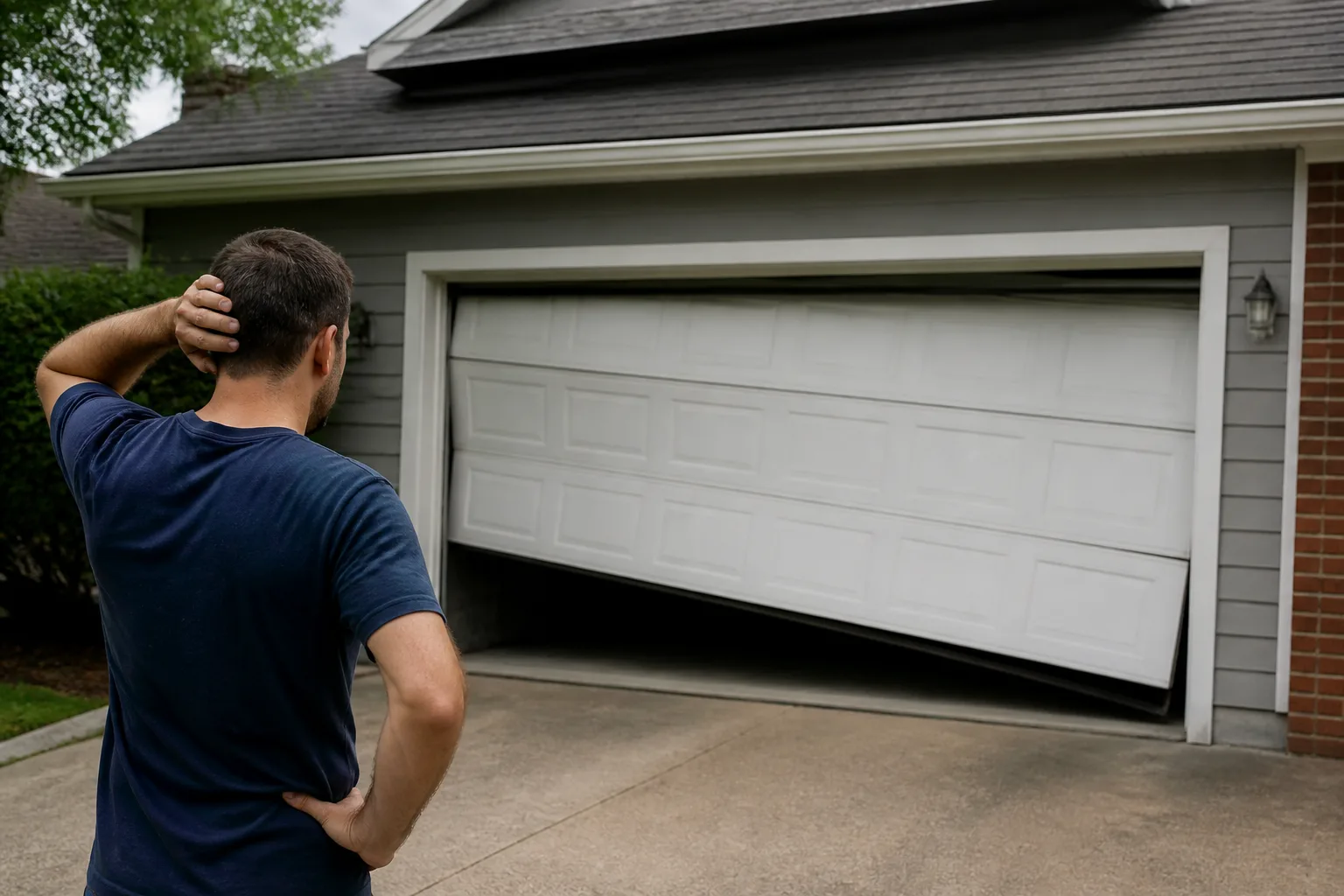
Before you do anything else, look at the door and answer three questions. Is it fully open, fully closed, or stuck halfway? Is it sitting level, or hanging crooked on one side? And can you see a spring or cable that looks broken, dangling, or wrapped in the wrong place?
A door that’s stuck halfway or hanging crooked is the one to treat with real caution. A torsion spring that has snapped, or a cable that’s come off its drum, means the door is being held by less than it was designed to carry. That’s a dangerous condition, and it’s not a problem you solve by pushing the door up or pulling it down by hand. Springs and cables store serious force. A trained technician with the right tools is the only safe way to release that tension.
Here’s what to check, safely, from a distance:
- The gap at the bottom: a door that won’t close all the way leaves daylight and an easy way in.
- The tracks: look for a bend, a dent, or a roller that’s popped out.
- The springs: a torsion spring above the door that’s separated into two pieces, or an extension spring that’s stretched and hanging, has failed.
- The cables: a cable off its drum or frayed is a stop sign. Don’t run the opener.
If any of that matches what you’re seeing, step back, keep everyone – especially kids and pets – clear of the door, and move to securing the opening.
How Do You Secure a Garage Door That’s Stuck Open?
If the door won’t come down, the priority shifts from fixing it to closing off the opening. What actually works is anything that makes the space look occupied and makes entry slow and loud. What gives false confidence is a flimsy barrier that makes you feel better but wouldn’t stop anyone.
Steps that genuinely help while you wait for a technician:
- Park a vehicle close to the opening if you can do it safely. It blocks the widest point of access.
- Leave exterior lights on and keep the house looking active. Light is a real deterrent.
- Use sturdy barriers, not tape. A couple of heavy-duty clamps or a piece of lumber across the opening is far better than caution tape or a plastic sheet.
- Lock the interior door between the garage and the house. This is the door that actually protects your living space, and it’s the one people forget.
- Move valuables out of the garage if it’s quick and safe to do so.
What doesn’t work: propping a broom handle against the door, stringing up plastic sheeting as if it were a wall, or trusting the opener to hold a door it’s already failed to move. Those create a false sense of security. In Huntsville, where a lot of garages sit right at the front of the house and face the street, a visibly open door is also an invitation, so closing off the opening and calling for repair in the same ten minutes is the right order.
Should You Use the Emergency Release Cord?
The emergency release cord is the red handle hanging from the opener rail, and it disconnects the door from the opener so you can move the door by hand. It’s useful in the right situation and genuinely dangerous in the wrong one. Use it when the door is in good mechanical shape but the opener has failed – a dead motor, a snapped belt, a door that’s stuck closed and you need to get a car out. Don’t use it when a spring is broken, a cable is off, or the door is hanging crooked. In those cases, releasing the door to manual control means you’re now holding up a door that’s far heavier than it should feel, and it can come down fast.
When it is safe to use, the process is simple: pull the cord straight down and back, then lift the door by hand slowly and deliberately. Never let it drop. If the door feels unusually heavy or won’t stay up on its own, stop and leave it. That heaviness is telling you something mechanical has failed, and a technician needs to see it before anything else is moved. The release cord is a convenience, not a repair.
What to Have Ready Before You Call for Emergency Repair in Huntsville
The single biggest reason an emergency repair turns into two visits is missing information. When the technician knows your door’s brand and the symptom before arriving, they can bring the right part the first time. We work on the major brands homeowners actually have – LiftMaster, Chamberlain, Genie, Raynor and others – so having the name on the door or the opener ready saves everyone a trip.
Before you dial, gather these details:
- Door brand and model if you can find it. It’s usually on a sticker inside the door or on the opener housing.
- Opener brand and model – LiftMaster, Chamberlain, Genie, and Raynor all have different controls and parts, and opener repair is its own specialty.
- The exact symptom: won’t open, won’t close, opens partway then reverses, makes a grinding noise, or the opener runs but the door doesn’t move.
- What you’ve already tried – whether you used the release cord, whether the wall button works but the remote doesn’t, whether the safety sensors are lit.
- Photos of the door, the opener, and any broken spring or cable.
With those in hand, a call to (855) 632-2899 gets you a real diagnosis instead of a guess. We answer 24/7, with fast dispatch from 7am to 7pm, Sunday through Friday. A call outside dispatch hours is booked into the next opening.
How to Judge an Emergency Repair Quote Under Pressure
Emergencies make people rush, and rushing is exactly when pricing gets loose. You can protect yourself by asking for two things: a written, itemized quote before any work starts, and a clear statement of whether the price is for one part or a pair. On a garage door, a spring price is for a single spring. Matched springs are usually replaced together, so a pair costs roughly twice the single-spring figure. If a quote blurs that line, ask which it is.
The second number that reveals fair pricing is the labor breakdown versus the parts. A trustworthy shop separates them. You should see the part cost, the labor, and any disposal, all before anyone picks up a tool. A price quoted and agreed before work begins is the price you pay. If someone can’t or won’t put it in writing, that’s your answer.
Ask directly: “Is this the total, and is it for one spring or the pair?” A straight answer comes back immediately. A vague one tells you to get a second call.
When to Call a Pro (and Stop DIY)
Call a professional the moment you see a broken spring, a cable off its drum, or a door hanging crooked. Those are the three situations where DIY turns into injury. Opener problems – a motor that hums but won’t lift, a remote that’s stopped working, safety sensors that keep tripping – are also worth a call, because your opener has a diagnosis, not just a symptom. And if repair versus replacement is genuinely unclear, that’s a conversation worth having before you spend. Repair or replace, we’ll tell you which one actually makes sense.
Related services in Huntsville: if you’re dealing with a failed spring or off-track door, our garage door repair team can help. If the door itself moves but the motor or remote won’t cooperate, garage door opener repair covers it. If the door is beyond repair, we handle full installation too. And if you’re new to the area or just want the lay of the land, you can read more about Huntsville and what local homeowners deal with.
The Bottom Line
The first ten minutes after a garage door fails are about safety first, security second, repair third. Don’t touch a spring or cable. Secure the opening if the door won’t close. Use the release cord only when the door’s mechanicals are sound. And have your brand and symptom ready so the repair happens in one visit instead of two. Our technicians have up to 12 years of experience, and we can work with your insurer if a repair turns into a claim.
If you’re in Huntsville and need help, Hawthorne Garage Door Repair offers free estimates and does repair, opener repair, and installation under one name. One call covers it. Call (855) 632-2899. We answer 24/7. Fast dispatch from 7am to 7pm, Sunday through Friday. And here’s the small consolation: a garage door always picks the worst possible moment to quit, but at least it can’t do it on a day we’re closed.
Frequently Asked Questions
Spring replacement typically runs $180 to $340 for a single spring, and a matched pair usually costs about twice that because both are replaced together. Opener repairs and cable or track fixes vary by the part and the diagnosis, so you get a written, itemized estimate before any work begins. The written quote sets the final price. Call (855) 632-2899 for an exact quote – estimates are free.
In most cases yes. We answer 24/7 and offer same-day service with fast dispatch from 7am to 7pm, Sunday through Friday. A call outside dispatch hours is booked into the next opening. If your door is stuck open, secure the opening first, then call (855) 632-2899.
No. You get a written estimate before work starts, and the price is quoted and agreed before anything is touched. If the diagnosis reveals something different once the door is inspected, we walk you through it and get your okay before the price changes. Nothing is added without your agreement. Call (855) 632-2899 with your door’s brand and symptom for the most accurate starting quote.
Our technicians are experienced and state-licensed, and we can work with your insurer if the repair is part of a claim. We service the major brands – LiftMaster, Chamberlain, Genie, and Raynor among them – so your specific system is covered. Call (855) 632-2899 to schedule.
Written by the team at Hawthorne Garage Door Repair.
Need Garage Door Help?
Call Hawthorne Garage Door Repair - licensed & insured, here with fast help in Huntsville.
(855) 632-2899